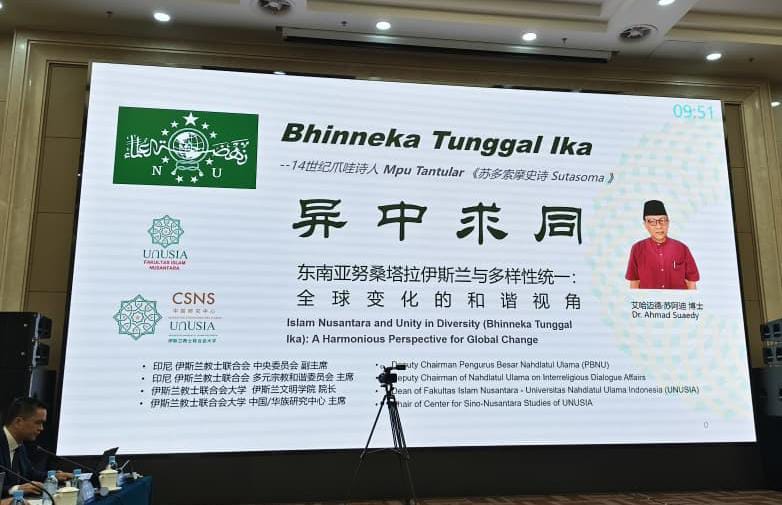
(Nanning, Guangxi, China, November 3) – Dr. Ahmad Suaedy, Deputy Chairman of the Central Board of Nahdlatul Ulama (PBNU) and Dean of the Faculty of Islamic Civilization (FIN) at Nahdlatul Ulama University (UNUSIA), attended the China–ASEAN Forum of Administrative Institutes and Think Tanks, held in Nanning, the capital of Guangxi Province, which borders ASEAN countries.
During his visit, Dr. Ahmad Suaedy met with Xie Chuntao, Executive Vice President of the Chinese Academy of Governance, and leaders of the Guangxi Zhuang Autonomous Region. At the thematic forum titled “Global Governance, Regional Governance, and the Asian Way”, he delivered a keynote speech titled “Islam Nusantara and Unity in Diversity (Bhinneka Tunggal Ika): A Harmonious Perspective for Global Change”.
The forum, hosted by the Chinese Academy of Governance, carried the theme “National Governance and Asian Civilization.” It gathered representatives from administrative academies and key think tanks across ASEAN member states to share their perspectives and experiences in advancing government modernization and governance capacity within the context of Asian civilizational traditions.
Participants included:
Peserta tersebut antara lain Kepala Lembaga Administrasi Negara Indonesia Muhammad Taufiq; Anggota Komite Sentral PKT merangkap Wakil Direktur Tetap Akademi Politik Nasional Ho Chi Minh Vietnam, Doan Minh Huan; Mantan Wakil Menteri Departemen Internasional Komite Sentral PKT yang juga Mantan Wakil Presiden Asosiasi Rakyat Tiongkok untuk Perdamaian dan Perlucutan Senjata, Yu Hongjun; Direktur Eksekutif StratSearch Foundation Filipina, Clarita Reyes Carlos; Wakil Presiden dan Profesor Senior Universitas Tunku Abdul Rahman Malaysia, Choong Chee Keong; Wakil Presiden Royal School of Administration Kamboja, Soly Vannpok; Anggota Komite Tetap Partai Akademi Politik dan Administrasi Publik Nasional (NAPPA) sekaligus Dekan Fakultas Sosialisme Ilmiah NAPPA Laos, Khambay Malasing; Rektor Akademi Layanan Sipil yang juga Dewan Layanan Sipil Persatuan Myanmar, Kyaw Soe; Direktur Hubungan Internasional Divisi Layanan Publik Singapura, merangkap Direktur Eksekutif CSC International, Civil Service College Singapura, Christopher Pragasam; serta Anggota Dewan Eksekutif dan Direktur Kantor Keterlibatan Sipil dan Inklusi Politik King Prajadhipok’s Institute Thailand, Kovit Puang-ngam.
Dr. Ahmad Suaedy visit to China since the establishment of the Center for Sino-Nusanrata Studies (CSNS) at UNUSIA FIN. In his speech, he elaborated on the influence of Nahdlatul Ulama in Indonesia and cited the famous phrase “Bhinneka Tunggal Ika” (“Unity in Diversity”) from the 14th-century Javanese poet Mpu Tantular’s epic Sutasoma, expressing hope for harmony across Asia.
He stated:
“Humanity is facing uncertainty not only in politics due to geopolitical changes, but also in core human values, which are also changing. Nations with different history and traditions but shared concerns are also required to collaborate to contribute strongly and collectively.
Eastern nations are nations that, over a long history, have possessed their own models of knowledge and wisdom beyond those currently mainstream in the world, which are primarily sourced from the modern West.
Indonesia is a large nation with a population of over 280 million, with hundreds of years of experience fostering harmony across ethnicities, religions, islands, kingdoms and sultanates, and strong and dynamic local traditions.
When Cheng Ho reached Nusantara, they not only played a crucial role in commerce but also had a significant influence on the Islamization of Java and Indonesia, as many Chinese Muslims accompanied Cheng Ho to Java.
We should jointly study and reflect upon this historical experience of harmonious coexistence, and through dialogue today, carry forward the tradition of mutual understanding and harmony between Nusantara Muslims and Chinese Confucian culture.
Spirituality and religion in Indonesia are not merely personal guidelines independent of the social and political spheres, but are part of the social and political structure itself.”
He further noted:
“In Indonesia, spirituality and religion are not merely personal beliefs independent of society and politics; they are inseparable components of social and political structures. The harmonious coexistence of religion and tradition is one of the core governance principles of the Indonesian government, often referred to as ‘religious moderation.’ The government provides guidance and education to the public, promoting respect, inclusiveness, and coexistence at all levels—especially across faith, behavior, tradition, politics, and governance.”
In conclusion, Dr. Suaedy remarked:
“I firmly believe that if we work together, building upon spirituality, religion, and our harmonious yet dynamic traditions, we can forge a new moral strength—one that transcends the self-centered and monopolistic patterns that have dominated the world under Western hegemony for centuries.”
Dr. Ahmad Suaedy and other participants agreed that the forum marks a positive beginning for dialogue and cooperation between PBNU—Indonesia’s largest social organization—and China, as well as among ASEAN administrative academies. It opened a friendly pathway for future collaboration in governance, management, and think-tank partnerships.